
Poetry under the olive trees of Palestine
This essay was first published in print for The Hindu
Often the question of the role of art is raised when human lives are at stake. Artists, creatives, intellectuals, you and me, pour all our thoughts into the endless vessel of conversations when we ask ourselves: what significance does art hold in the presence of unfathomable atrocities inflicted upon humanity?
In his book Memory of Forgetfulness, which delves into the 88-day siege of Beirut in 1982, poet Mahmoud Darwish recounts a conversation with his friend, the renowned Urdu poet Faiz Ahmad Faiz. It is regarding the role of art amidst the turmoil of the siege.
“Our great friend from Pakistan, Fayiz Ahmad Fayiz, is busy with another question: ‘Where are the artists?’
‘Which artists, Fayiz?’ I ask.
‘The artists of Beirut.’
‘What do you want from them?’
‘To draw this war on the walls of the city.’
‘What’s come over you?’ I exclaim. ‘Don’t you see the walls tumbling?’”
When our surroundings lack physical barriers, the practice of art can become seemingly impractical — an aspect that may contribute to the scarcity of Palestinian poetry in the well of the Internet. What does art then mean for us at this time as we witness a genocide unfold from the comfort of our bedrooms? Art is used to amplify voices, honour narratives, and uphold the dignity of those whose stories demand to be heard, especially in the face of cultural erosion.
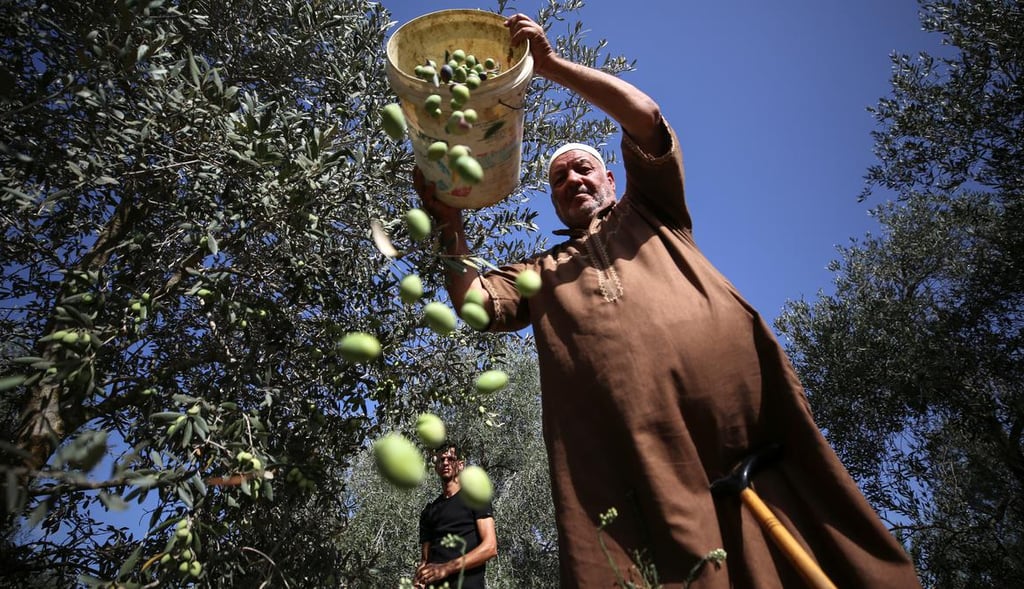
One such erosion is the uprooting of olive trees. Since 1967, Israel has uprooted around a million Palestinian olive trees alongside an unprecedented number of human lives. These revered trees not only form the backbone of the Palestinian economy but also hold deep cultural significance in Palestinian heritage. Olive trees serve as living chronicles of Palestine and are passed down through generations as family heritage.
Some of these ancient trees, dating back to many centuries, endure harsh conditions such as drought and poor soil, reflecting their inherent resilience. Rooted deeply in history and tradition, they are the testament of the Palestinian land. .
Palestinian poetry intricately maps the multifaceted meanings of these trees. In her poem ‘Different Ways to Pray’, American-Palestinian poet Naomi Shihab Nye invokes the pain of people who have died on the land of olive trees:
Under the olive trees, they raised their arms —
Hear us! We have pain on earth!
We have so much pain there is no place to store it!
But the olives bobbed peacefully
in fragrant buckets of vinegar and thyme.
At night the men ate heartily, flat bread and white cheese,
and were happy in spite of the pain,
because there was also happiness.
Despite the pain, the olive trees persist, bearing fruit as a testament to resilience and fortitude in the face of occupation. The olives they yield serve as a symbol of hope and strength, offering a source of joy amidst the surrounding turmoil — a balm for wounded spirits, a healing potion in a landscape scarred by conflict.
Politician and poet Tawfiq Ziad also looks at olive trees as a monument that holds the collective memories and histories of his fellow Palestinians, as well as his own. In the poem, ‘On The Trunk Of An Olive Tree’, Ziad embraces the longevity of an olive tree:
I shall carve the number of each deed
Of our usurped land
The location of my village and its boundaries.
The demolished houses of its peoples,
My uprooted trees,
And to remember it all,
I shall continue to carve
All the chapters of my tragedy,
And all the stages of the disaster,
From the beginning
To end,
On the olive tree
While one poet relies on the eternity of olives, for another even the wish to nurture them becomes deadly. Poet Taha Muhammad Ali in his poem, ‘The Fourth Quasida’, imagines his estranged lover, Amira, coming back with a peaceful dove.
A dove whose feelings of cold are fatal,
whose sense of strangeness can kill,
whose longing for the olive
grove is lethal.
Today, much of the olive groves are under Israeli control, making it perilous for Palestinians to access their land for harvesting. Ali here tells us that something as ordinary as longing for the olive grove is deadly. When nurturing becomes dangerous, the blood of Palestinians becomes the nurturer. In ‘The Second Olive Tree’, Darwish presents the portrait of the tree — one that is tender, peaceful and resilient — which gets uprooted and is reborn with the blood of Palestinian martyrs.
The portrait, for the olive tree is neither green nor silver.
The olive tree is the color of peace, if peace needed
A color. No one says to the olive tree: How beautiful you are!
But: How noble and how splendid! And she,
She who teaches soldiers to lay down their rifles
And re-educates them in tenderness and humility: Go home
And light your lamps with my oil!
In the later part of the poem, a grandson, who stood against the execution of the olive tree by the Israeli soldier gets martyred. He is buried at the same place in the hope of growing and becoming one with the olive tree. Palestinian martyrs’ blood irrigates the olive tree and nourishes it. In another poem, ‘The Earth is Closing on Us’, Darwish pictures the olive tree as a continuity to humans.
We will die here, here in the last passage.
Here and here, our blood will plant its olive tree.
The relationship between Palestinians and olive trees is nothing less than a blood relation.